Views: 0 Author: Site Editor Publish Time: 2026-10-30 Origin: Site
Managing material handling equipment requires precise replacement parts. A Request for Quotation for a cabin chair is not merely a commercial document. It is a technical blueprint. If you omit mechanical details, you risk buying incompatible or non-compliant hardware. This guide breaks down the exact engineering specifications your procurement documents need. Accurate specs mean accurate quotes, durable products, and zero installation delays on the shop floor.
Dimensional Accuracy: Bolt patterns, suspension clearances, and adapter plate requirements must be exact.
Safety Compliance: Operator presence switches and interlocks are now baseline requirements for modern fleets.
Ergonomic Metrics: Slide rail travel distance and weight adjustment ranges directly impact operator fatigue.
Commercial Clarity: Volumes, warranties, and exact delivery terms eliminate hidden vendor costs.
The material handling sector is rapidly shifting toward data-driven safety. Regulatory bodies now heavily scrutinize warehouse fleet telemetry. A modern RFQ must reflect this shift. You are no longer sourcing a basic cushion. You are sourcing an active safety node within a smart vehicle.
An RFQ differs fundamentally from a general proposal request. You already know exactly what you need. A vague request yields quotes for incompatible hardware. This creates hidden modification costs and severe dock delays. A highly detailed RFQ signals to manufacturers that you are a serious buyer ready to execute. It forces vendors to provide competitive proposals based on your fleet's actual mechanical realities.
The foundation of any seating quote lies in mechanical accuracy. Bolt patterns must be specified down to the millimeter. Universal replacements often require adapter plates, so clarify if your maintenance team can accommodate this. Let us look at specific parameters. A standard forklift seat should feature a fore and aft adjustment of at least 150mm and a weight adjustment range spanning from 50kg to 130kg. These specific numbers must be in your document.
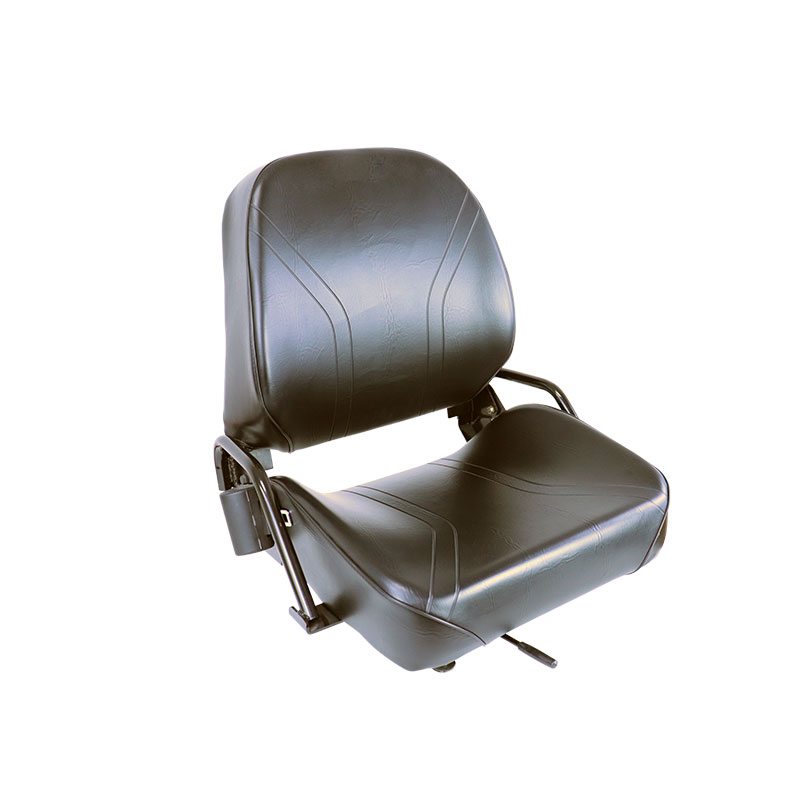
Operating environments dictate material choices. Standard cloth fails quickly in harsh outdoor or construction settings. For these applications, you must specify a heavy-duty black forklift seat constructed from seamless PVC. Demand integrated water drain holes in the specification. This simple feature prevents moisture pooling and drastically extends the lifecycle of the upholstery.
Component | Vague RFQ Description | Engineering-Grade RFQ Specification |
|---|---|---|
Mounting | Fits most forklifts | Universal mounting with 328 x 285 mm bolt pattern |
Weight Capacity | Heavy duty suspension | Adjustable mechanical suspension for 50-130 kg operators |
Upholstery | Waterproof material | Seamless black PVC with central water drain hole |
Ergonomics directly impact operator fatigue and warehouse throughput. A fixed chair is a mechanical liability. Your RFQ must mandate an adjustable slides forklift seat. This is a non-negotiable baseline for modern operations.
What exact ergonomic metrics should you specify? Require a folding backrest with a customizable angle, typically adjustable between 8 degrees and 80 degrees. This allows operators of all statures to reach the foot pedals safely. Do you need a document pouch or padded armrests? List them as mandatory line items. Do not leave them as optional add-ons for the supplier to upsell later.
Safety is where commercial value meets compliance. A vehicle tip-over with an unrestrained operator is a catastrophic liability. Your RFQ must demand active safety integrations, not just passive restraints.
Specify a belt alarm forklift seat. This utilizes a built-in microswitch to trigger a telemetry warning if the restraint is bypassed. Next, mandate an Operator Presence Switch. This critical sensor cuts off the transmission and hydraulic lift the second the driver stands up. State the required voltage and connector type for these switches to ensure seamless integration with your existing vehicle wiring harness.
Commercial terms require the exact same precision as technical specs. Outline your exact order volume. Are you buying 50 units for a comprehensive fleet overhaul, or setting up a 12-month supply contract for sporadic replacements?
Demand itemized pricing. The quote must separate the base unit cost, bulk discounts, freight charges, and import duties. Specify your absolute deadline for delivery. Ask for standard manufacturing lead times and precise packaging requirements to prevent transit damage to sensitive suspension components.
A low upfront price is useless if the suspension collapses after three months. Establish a strict baseline warranty expectation. Demand 12 to 24 months of coverage. Ensure this explicitly covers high-wear components like slide rails and electronic safety sensors.
Ask vendors to confirm the long-term availability of spare parts. Can you buy a replacement cushion or a standalone microswitch five years from now? Extending the lifecycle of the base unit maximizes your initial procurement investment.
When quotes arrive, use a standardized evaluation matrix. Assign weighted scores to price, technical compliance, safety robustness, and promised lead times. This removes emotion from the purchasing decision.
Look past the price tag. Review the manufacturer's ISO certifications. Request mechanical CAD drawings. If a supplier cannot provide detailed electrical specifications for their safety switches, they are likely cutting corners on quality. Reject quotes that fail to meet your engineering baselines.
Drafting a precise RFQ eliminates vendor guesswork. It ensures you procure equipment that fits perfectly and actively protects your workforce. Stop wasting time on incompatible parts and vague supplier promises. When you are ready to upgrade your fleet, evaluate your specific operational needs and source engineered solutions. We highly recommend checking the exact parameters and exploring the full range of compliant, heavy-duty options at Everwin Seats to find the perfect match for your next procurement cycle.
The most critical specification remains the mounting hole pattern and physical dimensions. If the hardware does not physically align with your vehicle chassis, no amount of advanced safety features will matter. The unit becomes entirely useless without expensive, time-consuming modifications.
A universal replacement model is frequently more cost-effective and engineered to fit multiple equipment brands. This makes it an ideal choice for facilities managing a mixed fleet. Just ensure your RFQ explicitly specifies the inclusion of any necessary universal mounting brackets.
This specialized seating features an integrated electronic sensor that immediately alerts warehouse management via telemetry if the seatbelt remains unfastened. Mandating this enforces stringent safety compliance and serves as a frontline defense against severe workplace accidents.
No. Many basic economy models are entirely fixed to reduce manufacturing costs. You must explicitly mandate adjustable sliding mechanisms with a specific travel distance in your RFQ to ensure optimal ergonomic positioning and safe pedal operation.
For machinery operating outdoors, your RFQ should demand heavy-duty, weather-resistant upholstery. A dark, seamless PVC construction equipped with integrated water drainage channels is highly recommended to prevent rainwater accumulation and resist UV degradation.
Measure the distance between the center of the bolt holes from front to back, and then from left to right. Provide these exact millimeter dimensions in your RFQ. This prevents the need for drilling or custom plate fabrication during installation.
For standard configurations, expect 2 to 4 weeks. However, if your RFQ specifies custom wiring harnesses for safety switches or non-standard upholstery, lead times can easily extend to 6 or 8 weeks. Always state your absolute deadline in the initial request.