Views: 366 Author: Site Editor Publish Time: 2026-07-01 Origin: Site
A seat slider functions as a critical structural component responsible for kinetic energy transfer, driver feedback, and safety under load. When a driver steps heavily on the brakes or a machine operator navigates uneven terrain, the seat mechanism absorbs massive shear forces. Selecting the wrong track mechanism leads to immediate structural compromises. Seat flex during heavy braking destroys pedal precision, uneven rails bind and refuse to adjust, and inadequate locking mechanisms pose severe safety risks in motorsport or heavy industrial applications.
This guide provides an evidence-based, technical evaluation of single-lock versus double-lock mechanisms. By detailing mechanical trade-offs, installation realities, and application-specific recommendations, you will gain the necessary insight to select the exact rail system required for your chassis, simulator rig, or heavy equipment cabin without relying on guesswork.
Mechanical Security: Double-lock seat sliders engage both adjustable seat rails simultaneously, eliminating the diagonal pivot (seat twist) inherent in single-lock designs under heavy acceleration or braking.
Application Thresholds: Single-lock mechanisms are generally restricted to light-duty street use or passenger seats, whereas double-lock systems are mandatory for motorsport, heavy equipment, and load-cell sim racing cockpits.
Installation Tolerances: Double-lock sliders require significantly higher precision during installation; a misalignment of even a few millimeters between rails will cause the mechanism to bind or lock asynchronously.
Material Rigidity: High-quality double-lock systems frequently utilize thicker gauge steel (e.g., 1/8" steel brackets) to withstand higher shear forces compared to standard single-lock alternatives.
Compatibility Check: Seat slider selection is highly dependent on mounting configuration (bottom-mount vs. side-mount) and the footprint of the specific aftermarket seat brand (e.g., Corbeau, Sparco, Recaro).
An effective track mechanism must meet strict operational standards. Zero unwanted deflection under load is the primary requirement. When a driver applies force to the pedals or steering wheel, the seat must remain completely rigid. Smooth travel across the entire adjustment range is equally critical, ensuring operators can reposition themselves without fighting bound tracks. Positive engagement means the locking pins seat deeply and securely into the track notches without micro-play. Finally, structural integrity dictates that the rails will not deform, shear, or separate during crash loads or sustained heavy vibrations.
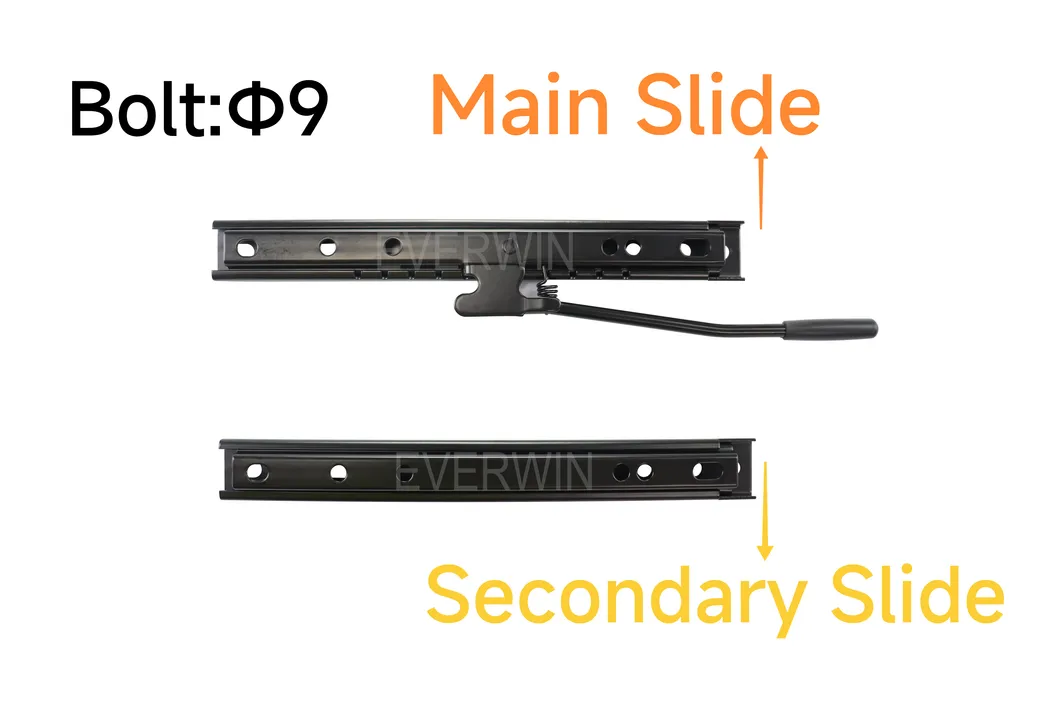
A single-lock seat slider relies on a simplified mechanical design. A single lever engages locking teeth on only one of the two tracks. The opposite side functions strictly as a "follower" rail. This non-locking side simply glides along its channel without any mechanical engagement to the floor bracket.
Because only one side anchors the seat longitudinally, these mechanisms are primarily found in OEM passenger seats, light-duty street applications, and budget aftermarket setups. The lack of a secondary lock makes them lighter and easier to install, but inherently vulnerable to twisting forces. When you push hard against the seat back, the unlocked side shifts slightly, creating a pivot effect that degrades stability.
A double-lock seat slider utilizes a unified actuator bar, often shaped like a horseshoe or utilizing a wire linkage, to connect locking pins on both the left and right rails. When the operator pulls the handle, it releases both sides simultaneously.
This dual-engagement principle ensures both rails lock into the chassis at the exact same time. The result is a rigid, squared structure that resists diagonal deflection. These robust mechanisms are the standard for high-G motorsport, heavy industrial machinery, and rigid sim racing chassis where structural compromise is unacceptable. The dual locking points distribute the load evenly across the mounting surface.
Understanding how your seat mounts to the rails is a mandatory step before purchasing hardware. Direct bottom-mount seats bolt straight down into the slider tracks. Side-mount seats require vertical brackets that bolt to the sides of a composite or aluminum shell, which then bolt down into the slider.
Aftermarket brand dimensions heavily influence slider selection. Brands like Corbeau often feature wider mounting footprints, while Sparco and Recaro utilize different standard spacings. You must ensure the adjustable seat rails you select align perfectly with both the seat's bolt pattern and the vehicle's floor pan or base bracket. Using mismatched hardware leads to forced installations, bent rails, and immediate binding.
The physics of single-lock flex become obvious under heavy braking. When force pushes the driver backward, the locked rail holds firm, but the non-locking follower rail allows micro-movement. This creates a pivot point, leading to diagonal seat twist. Over time, this twisting fatigues the metal and ruins driver feedback. You can feel the seat shift under you, which destroys confidence during high-performance driving or heavy equipment operation.
Double-lock rigidity solves this by distributing shear force evenly across the floor pan. Because both sides anchor securely, the seat cannot pivot. The dual-locking points maintain a perfectly square geometry, transferring energy directly into the chassis rather than absorbing it through structural deflection. This creates a solid connection between the operator and the machine.
Motorsport sanctioning bodies like the FIA, SCCA, and NASA universally mandate double-locking mechanisms or fixed mounts for driver seats. A single-lock mechanism simply cannot withstand the extreme G-forces of a track impact without shearing or releasing. The sheer force of a collision will rip a single locking pin out of its track.
Premium double-locking systems integrate thick, hot-rolled steel brackets to prevent failure under extreme crash loads. In heavy machinery, safety standards require similar robustness to handle constant vibration isolation and integrate safely with Rollover Protection Systems (ROPS). A failing seat track in a rollover scenario is catastrophic.
Single-lock installations are highly forgiving. Because the follower rail floats freely, minor misalignments in the floor bracket rarely cause the track to bind. You can often bolt them down quickly without measuring exact parallel tolerances. The follower rail simply adjusts to the angle of the locked rail.
Double-lock systems demand strict parallel alignment. If the mounting floor or brackets are uneven or out of square by even a few millimeters, the mechanism will bind. The locking pins will drag against the track, preventing smooth adjustment or causing asynchronous locking where only one side engages. This requires careful measurement, shimming, and a specific tightening sequence.
Feature | Single-Lock Slider | Double-Lock Slider |
|---|---|---|
Locking Points | One rail (other is a follower) | Both rails simultaneously |
Structural Rigidity | Prone to diagonal twist under load | Highly rigid, zero pivot flex |
Installation Tolerance | Forgiving, easy to align | Strict parallel alignment required |
Primary Applications | Passenger seats, light street use | Motorsport, sim racing, heavy equipment |
High-end sim racing utilizing load cell or hydraulic pedals requires upwards of 100kg of leg force to achieve maximum braking. This extreme pressure necessitates a double-lock mechanism. Single-lock flex ruins braking muscle memory; if the seat twists backward diagonally every time you threshold brake, your consistency drops drastically. You cannot build repeatable braking techniques if your seating position shifts under load.
Integrating these sliders into an aluminum profile (8020) cockpit presents specific challenges. Slot-nut alignment must be perfect. Using dedicated mounting plates between the profile and the tracks helps prevent twisting and ensures the rails remain perfectly parallel during heavy use. Direct mounting to the profile channels often leads to binding if the crossmembers are not perfectly square.
Safety imperatives dictate double-locking rails during high-G cornering and potential impact scenarios. A single-lock track is a severe liability on a circuit. Double-lock sliders integrate seamlessly with FIA-approved side-mount brackets, ensuring the driver, seat, and racing harnesses operate as a unified safety cell. When pulling high lateral Gs, the seat must hold the driver firmly in place without any track deflection.
There are scenarios where a single-lock mechanism remains perfectly adequate. The passenger side of a street-driven tuner car rarely sees the pedal-induced shear forces experienced by the driver. In these non-critical seating positions, the marginal weight-saving benefits and easier installation of single-lock systems make them a practical choice. They simplify the build process without compromising the primary driver's experience.
When conducting an equipment seat slider comparison, operator fatigue and vibration frequency are top priorities. Tractors, forklifts, and excavators subject seats to relentless vertical and lateral shocks. Robust, dual-locking mechanisms are necessary to prevent the seat from rattling loose or adjusting unexpectedly during hazardous operations. A single-lock track will quickly wear out its locking teeth under constant industrial vibration.
The most common symptom of a poor installation is a slider that refuses to move forward or backward, or where only one side locks into place. This indicates the tracks are not parallel. The internal bearings bind against the steel housing, locking the entire assembly solid.
Mitigate this by following a strict alignment protocol. Leave all mounting bolts finger-tight. Actuate the slider through its full range of motion to naturally center the rails. Once the tracks glide smoothly, torque the bolts down in a cross-pattern to prevent pulling the assembly out of square. Use shims if the floor pan is uneven.
Asynchronous locking occurs when one rail engages a locking notch while the opposing rail rests between notches. This leads to micro-play, rattling, and diagonal twisting under load. You will hear a distinct clicking sound as the unlocked side shifts back and forth.
Mitigate this by standardizing the actuator bar bend angle. Ensure both rails are perfectly synchronized relative to their starting tooth notches before securing the handle. If one rail is a tooth ahead of the other, loosen the linkage, align the pins, and retighten. Always test the locking engagement before finalizing the installation.
A frequent frustration is discovering slider holes do not align with the seat base, sub-frame, or floor bracket. This halts installation immediately and forces you to modify structural components, which weakens the assembly.
Mitigate this by verifying bolt-hole pitch measurements before purchase. If mounting to a custom floor pan, use heavy-duty adapter plates or high-tensile (Grade 8 / Class 10.9) hardware to bridge the gap safely without compromising structural integrity. Never drill new holes directly into the slider tracks, as this destroys their load-bearing capacity.
Sometimes the double-lock connecting bar hits the floor pan, aluminum profile crossmembers, or the bottom of the seat base padding, preventing the pins from fully disengaging. You pull the handle, but the seat won't move.
Mitigate this by measuring vertical clearance before final torque. You may need to modify or bend the actuator bar slightly—within manufacturer tolerances—to clear obstructions and allow full upward travel of the release handle. Ensure the handle has at least an inch of clearance at full extension.
To finalize your seating setup, follow these exact steps:
Measure the longitudinal and lateral bolt hole pitch of your current seat base to ensure exact compatibility with the new track mechanism.
Inspect your vehicle's floor pan or simulator chassis for level mounting surfaces, acquiring steel shims if the mounting points are uneven.
Select a Seat Slider rated specifically for your application, defaulting to double-lock systems for any environment involving heavy braking, motorsport, or industrial machinery.
Install the tracks using Grade 8 hardware, leaving bolts finger-tight while cycling the seat through its full range of motion to guarantee parallel alignment before final torque.
A: No, the internal mechanisms and rail designs are fundamentally different. A full replacement of the adjustable seat rails is required to achieve dual-locking functionality.
A: Usually due to rail misalignment during installation. If the rails are not perfectly parallel, the locking pins will bind against the track, preventing smooth forward and backward movement.
A: Highly recommended, especially if using load cell pedals. Single-lock sliders will flex under heavy braking, causing the seat to twist and reducing braking accuracy and muscle memory consistency.
A: No. You must match the bolt pattern (pitch and width) of the seat slider to the bottom of your specific seat, aftermarket brand brackets like Corbeau or Sparco, or side-mount brackets.
A: Double-locking sliders are marginally heavier due to the secondary locking mechanism, thicker steel construction, and the connecting actuator bar, typically adding 1-3 lbs depending on the brand.
A: While many are marketed as universal, they require specific floor brackets, adapter plates, or aluminum t-slot hardware to mate safely with a vehicle's factory floor pan mounting points or a sim cockpit.
A: This occurs when the rails are out of sync. Loosen the actuator bar, manually slide both rails all the way back to their physical stops to reset them to a zero-point, ensure both locking pins are fully engaged in the first notch, and then re-torque the handle linkage.