Views: 228 Author: Site Editor Publish Time: 2026-07-10 Origin: Site
Operating a wheel loader involves continuous exposure to high-impact shocks, uneven terrain, and low-frequency oscillations that standard static seating cannot absorb. Prolonged exposure to heavy equipment vibration accelerates operator fatigue, increases the risk of musculoskeletal injuries, and directly degrades cycle times and shift productivity. Upgrading to a purpose-built Wheel Loader Seat is not merely an operator perk; it is a measurable risk management and operational efficiency strategy. This guide breaks down the technical evaluation of suspension systems, comparing mechanical and air-ride options to determine the optimal investment for your fleet.
Vibration Mitigation is a Compliance and Health Issue: Effective suspension systems reduce Whole-Body Vibration (WBV), aligning with occupational health standards and reducing long-term liability.
Air vs. Mechanical Depends on Application: Air suspension offers superior dynamic damping for continuous, high-hour operations, while mechanical suspension provides a reliable, low-maintenance baseline for intermittent use.
Fore/Aft and Lateral Isolation are Critical: In wheel loaders, horizontal and side-to-side shock absorption is just as critical as vertical damping due to the nature of bucket loading, gear shifting, and articulated steering.
Address the "Bounce" Concern: Quality air-ride seats utilize adjustable damping to eliminate the uncontrolled "bouncing" sensation, ensuring operator stability during high-impact loading.
Fitment Dictates Feasibility: Selecting a wheel loader replacement seat requires strict attention to cab dimensions, mounting bolt patterns, and electrical compatibility (12V/24V) for onboard compressors.
Earthmoving operations take a severe physical toll on equipment operators. Whole-Body Vibration (WBV) occurs when mechanical oscillations transfer from the machine chassis through the seat and into the human spine. Over time, this constant kinetic energy causes cumulative damage to spinal discs and lower back muscles. Industry standards, such as ISO 7096 for earthmoving machinery seating, establish baseline requirements for operator protection. Failing to mitigate these forces correlates directly with increased workers' compensation claims and chronic absenteeism. Operators running machines for ten to twelve hours a day absorb thousands of micro-impacts. When a loader hits a rut or drops a heavy load of aggregate, the shockwave travels straight up the steering column and through the floorboards. Without a proper suspension mechanism, the human body becomes the primary shock absorber. This leads to fatigue, decreased situational awareness, and long-term joint degradation. Fleet managers must view seating as a primary safety device rather than a cab accessory.
Seat suspension systems interact continuously with the wheel loader's chassis and suspended axles. When a machine traverses rough terrain, the axles and tires absorb initial impacts, but residual kinetic energy travels upward. A properly calibrated suspension seat must prevent harmonic resonance. This means the seat's vibration damping frequency cannot compound or amplify the natural oscillations of the axles and tires. If the frequencies align, the operator experiences magnified shocks rather than reduced impacts. Wheel loaders often operate in V-pattern loading cycles, shifting rapidly between forward and reverse. This creates a rocking motion that interacts with the machine's wheelbase. The suspension seat must isolate the operator from these specific dynamic shifts. Engineers design these seats to break the frequency chain between the rigid steel frame of the loader and the operator's seating position. Proper isolation keeps the operator's sightline stable, allowing for precise bucket placement and safer maneuvering around ground personnel.
Fatigue degrades reaction times and precision during bucket operations. When operators brace against continuous impacts, their physical endurance drops rapidly. Investing in loader operator comfort yields measurable returns. Operators utilizing high-quality suspension systems achieve faster cycle times and maintain focus throughout longer effective operating hours. Providing a safe, comfortable cabin environment improves operator retention in an increasingly tight labor market. A comfortable operator is an efficient operator. When the back pain stops, the focus shifts entirely to the task at hand. They can push the machine closer to its operational limits without feeling battered at the end of the shift. This translates to more tons moved per hour, fewer spilled loads, and reduced wear on the machine's drivetrain due to smoother control inputs. The correlation between a high-quality seat and daily output is undeniable on any active job site.
Mechanical suspension seats rely on heavy-duty coil springs and hydraulic shock absorbers to manage vertical loads. Operators adjust the suspension tension manually using a dial or lever to match their body weight. While these manual weight adjustment mechanisms are effective, they have limitations if operators fail to calibrate them correctly during shift changes. Mechanical seats are ideal for older machines, lower-hour usage scenarios, and environments hostile to electrical components where simplicity equals reliability. They do not require a power source, making installation straightforward. You bolt them down, and they are ready for work. However, the steel springs have a fixed response rate. They handle large, sudden impacts well but struggle to filter out the high-frequency, low-amplitude vibrations that cause long-term fatigue. Maintenance involves keeping the slide rails clean and occasionally checking the shock absorber for fluid leaks. For a backup loader or a machine used primarily for yard cleanup, a mechanical seat provides adequate protection without unnecessary complexity.
Air suspension systems utilize pneumatic air springs powered by integrated 12V or 24V compressors. These advanced units offer automatic weight equalization and active ride height maintenance. When an operator sits down, the system adjusts the air pressure to keep the seat at the optimal suspension stroke midpoint. A wheel loader suspension seat equipped with air technology excels in high-frequency vibration environments and continuous, multi-shift operations. The air bladder provides a variable spring rate. As the seat compresses, the resistance increases smoothly, preventing harsh bottoming out. This progressive damping is vastly superior to steel coils for isolating the operator from engine vibrations and drivetrain chatter. The onboard compressor requires a clean power feed, usually wired directly to the machine's fuse panel. Air seats often include additional features like pneumatic lumbar support, which uses small air pockets to contour the backrest to the operator's spine. This level of adjustability makes air suspension the standard for primary production machines.
Static or shell seats lack internal suspension mechanisms. They suffer from severe structural limitations in heavy earthmoving applications. Rigid mounting transfers 100% of chassis kinetic energy directly to the operator's spine. The long-term cost of static seats manifests in operator injuries and reduced daily output. Upgrading to an aftermarket suspension seat is always worth the upfront investment compared to basic shell replacements, as it fundamentally changes how the operator interacts with the machine. Running a loader with a static seat over rocky terrain is physically punishing. Every rock, pothole, and gear shift sends a jolt through the cab floor. Operators instinctively slow down to protect themselves, which kills productivity. Static seats belong on smooth-surface warehouse forklifts, not on articulated earthmovers. Replacing a static seat with a proper suspension unit is the single most effective ergonomic upgrade you can perform on a piece of heavy equipment.
Suspension Type | Primary Mechanism | Best Application | Vibration Isolation Level |
|---|---|---|---|
Mechanical | Coil Springs & Hydraulic Damper | Low-hour machines, older fleets | Moderate |
Air Ride | Pneumatic Bladder & Compressor | Primary production, multi-shift | High |
Static | Rigid Mount | Smooth surface only (Not recommended) | None |
Evaluating suspension types requires comparing the stroke length and damping efficiency of air bladders versus steel coils. Air bladders provide a smoother, more progressive resistance curve. Operators often express concerns about stability. Proper hydraulic damper tuning in high-quality air seats prevents the "too much bounce" effect. This ensures the seat does not act like a trampoline during aggressive digging and dumping cycles, keeping the operator firmly positioned behind the controls. When a loader rams into a pile of dense material, the sudden deceleration throws the operator forward. The seat must absorb the vertical drop as the front tires bite in, without rebounding violently. Mechanical seats can sometimes kick back aggressively if the shock absorber wears out. Air seats, when properly maintained, offer a controlled compression and a slow, damped return to the neutral position. This controlled movement is what separates a premium seat from a budget replacement.
Multi-operator machines require quick adjustments between shifts. Mechanical seats involve the friction of manual adjustments, which operators frequently ignore. This leads to the risk of bottoming out if the seat is improperly calibrated for a heavier user. Air seats offer push-button ease. The operator simply taps a valve switch, and the internal compressor instantly adjusts the air bladder to the correct pressure, ensuring optimal suspension travel regardless of the user's weight. If a 250-pound operator takes over from a 160-pound operator and forgets to adjust a mechanical seat, the suspension will bottom out on the first major bump, sending a massive shock into their spine. With an air seat, the adjustment takes three seconds. You push the button until the seat lifts you to the correct height, and the internal valving handles the rest. This simplicity guarantees that the suspension is actually used correctly on busy job sites.
Mechanical seats present a lower upfront cost and fewer complex failure points. Steel springs experience faster physical degradation and metal fatigue over time. Air seats require a higher initial investment and depend on electrical integrity to power the compressor. Despite this, air systems offer a longer service life for the primary damping mechanism. They provide better long-term returns for high-use assets by maintaining consistent shock absorption year after year. Dust and grit are the enemies of any moving part in a loader cab. Mechanical slide rails and spring pivots need regular greasing to prevent binding. Air seats enclose the critical components within a rubber boot, protecting the air bladder and scissor mechanism from debris. The main failure point on an air seat is usually a pinched airline or a blown fuse for the compressor. Regular cab cleaning and careful routing of the power wires during installation mitigate these risks entirely.
Check the rubber dust boot for tears or dry rot monthly.
Verify the compressor power wire is free from chafing against the seat frame.
Lubricate the fore/aft slide rails with dry graphite spray to prevent dust buildup.
Test the manual weight adjustment dial on mechanical seats to ensure it turns freely.
Inspect the seatbelt mounting points for secure attachment to the suspension base.
Wheel loaders specifically require horizontal shock absorption to counteract the "bucking" motion of bucket penetration into dense material piles. Fore/aft isolators allow the seat top to glide slightly forward and backward, absorbing these horizontal impacts. Lateral isolators manage articulated steering forces. They absorb the side-to-side whip action common in articulated wheel loaders, preventing the operator from being thrown sideways during tight maneuvers. When you articulate a loader fully to the left or right, the cab swings in an arc. This generates lateral G-forces that vertical suspension cannot handle. A seat equipped with lateral isolation shifts sideways up to an inch in either direction, absorbing that whip effect. This keeps the operator's hands steady on the steering wheel and joystick. Without lateral isolation, the operator constantly fights to stay centered in the seat, leading to severe core muscle fatigue by the end of the day.
A proper wheel loader replacement seat must include adjustable lumbar support, seat pan tilt, and multi-angle armrests. These features accommodate different body types and promote healthy spinal alignment. Seat top contouring is equally vital. High-density foam cushions and deep side bolsters prevent the operator from sliding laterally during sharp turns or uneven terrain navigation. The seat pan tilt is particularly important for loader operators. Because they constantly look up at the bucket at full extension, tilting the seat pan back slightly relieves pressure on the back of the thighs and improves blood circulation to the legs. Adjustable armrests are non-negotiable. They must support the weight of the operator's arms while operating the hydraulic controls. If the armrests are too low, the operator hunches forward. If they are too high, the shoulders tense up. Multi-angle adjustment ensures a perfect fit.
Evaluating upholstery materials depends entirely on the working environment. Fabric or cloth covers offer excellent breathability, making them ideal for climate-controlled, enclosed cabs. Heavy-duty vinyl or Cordura fabrics provide superior water resistance and durability. These rugged materials are necessary for open cabs, dusty quarries, or wet environments where operators frequently enter the machine with soiled gear. Vinyl is easy to wipe down at the end of a shift, but it gets extremely hot in direct sunlight and causes sweating. Cloth is comfortable but absorbs grease and dirt quickly. For severe-duty applications, heavy-duty woven nylon like Cordura offers the best compromise. It resists tearing from tool belts, repels water reasonably well, and breathes better than solid vinyl. Always consider the cab environment before selecting the seat covering.
Modern earthmoving equipment relies heavily on ergonomic control setups. Ensure the replacement seat can accommodate pod-mounted joysticks or integrated equipment controls. The armrests and side consoles must align perfectly with the operator's natural resting position. The seat design must support these control modules without restricting the operator's physical movement or visibility within the cabin. Many newer loaders mount the hydraulic joysticks directly to the seat frame rather than the side console. This means the controls move up and down with the suspension, keeping the operator's hands perfectly aligned with the joysticks regardless of the terrain. If you are replacing a seat in one of these machines, you must select a model with heavy-duty side brackets designed specifically to carry the weight of the control pods. Failing to account for this will result in a seat that cannot be installed.
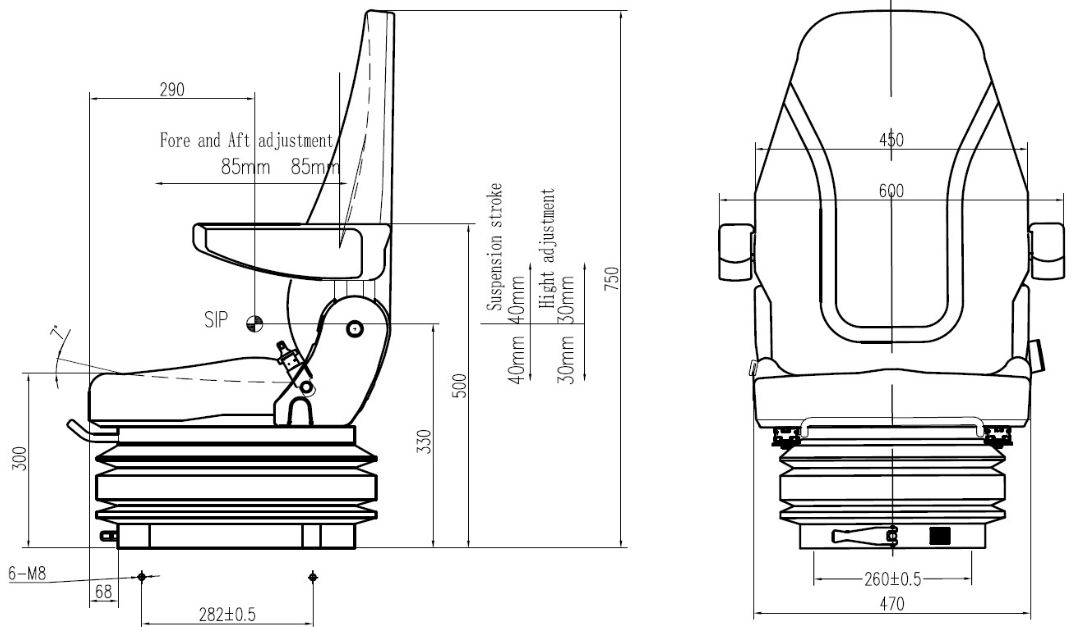
Retrofitting heavy equipment seating involves specific technical hurdles. You must measure the Suspension Information Profile (SIP) and verify whether the seat uses a universal or custom bolt pattern. Cab space constraints are critical. Mitigate the risk of cab roof interference by verifying the seat's maximum suspension stroke. You must ensure the upward travel does not push tall operators into the headliner during severe impacts. Measure the distance from the floor to the roof, and subtract the height of the operator and the maximum upward stroke of the seat. If the clearance is less than three inches, you need a low-profile suspension base. Bolt patterns vary wildly between manufacturers. While many aftermarket seats feature slotted mounting plates to accommodate different floor layouts, you may still need an adapter plate. Never drill new holes in the cab floor without verifying what lies beneath, as you risk puncturing hydraulic lines or wiring harnesses.
Before ordering an air suspension seat with an internal compressor, verify the machine's electrical output. Connecting a 12V seat to a 24V system will destroy the compressor immediately. Some machines feature existing onboard air systems. In these cases, you must decide whether to tap into the machine's air supply or utilize a self-contained seat compressor for simpler installation. Tapping into the machine's air brake system requires specific DOT-approved fittings and valves to ensure you do not compromise the loader's braking capacity. For most retrofits, a seat with a self-contained 24V compressor is the safest and easiest route. You simply run a fused power wire to an ignition-switched terminal on the fuse block and attach the ground wire to a clean metal point on the cab frame. Always use proper wire loom and grommets to protect the wiring from chafing.
Modern wheel loaders require strict safety compliance. You must integrate Operator Presence Switches (OPS) into the new seat. These sensors prevent machine operation or hydraulic movement when the seat is empty. Verify seatbelt compatibility. Determine whether the machine requires 2-point or 3-point harnesses, and ensure the seat frame meets ROPS (Roll-Over Protective Structure) compliance standards for operator safety. The OPS is usually a simple two-wire pressure switch located under the bottom cushion. When replacing the seat, you must splice the new seat's switch into the machine's wiring harness. If the switch operates on a normally open circuit and the machine requires a normally closed circuit, you will need a relay to reverse the signal. Never bypass the OPS. Bypassing safety switches creates massive liability and endangers everyone on the job site. Ensure the seatbelt tethers bolt directly to the reinforced points on the suspension base, not just the sheet metal of the seat pan.
Measure the existing floor bolt pattern (width and depth).
Check the cab voltage at the fuse panel (12V vs 24V).
Measure the vertical clearance from the floor to the headliner.
Identify the wiring requirements for the Operator Presence Switch.
Determine if the hydraulic joysticks mount to the seat or the cab console.
The choice between mechanical and air suspension hinges on machine utilization rates, operator preferences, and budget constraints. Specify mechanical suspension for low-hour or single-operator machines where simplicity is favored. Mandate air suspension for primary production loaders and multi-shift operations where maximizing cycle-time efficiency is a priority. Upgrading your seating directly impacts the daily output and physical health of your operators. Do not treat it as an afterthought.
Measure your current seat's bolt pattern and cab dimensions to ensure proper fitment.
Verify your loader's electrical voltage to select the correct compressor rating.
Assess your machine's steering configuration to determine the need for lateral isolators.
Consult with a heavy equipment seating specialist to match the exact model to your loader.
A: Air ride seats use pneumatic air bladders and onboard compressors to absorb shocks, offering push-button weight adjustment and superior dynamic damping. Mechanical seats rely on steel coil springs and hydraulic shock absorbers, requiring manual dial adjustments to set the suspension tension based on operator weight.
A: No. High-quality air seats use integrated hydraulic dampers to control the rebound rate. This prevents the trampoline effect, providing a stable, controlled platform even during high-impact loading and aggressive bucket penetration.
A: You must check the bolt mounting pattern on the cab floor. Measure the cab width, verify the dynamic stroke clearance to avoid roof interference, and check the Suspension Information Profile to ensure proper joystick alignment.
A: Articulated steering causes sharp side-to-side whip forces that standard vertical suspension cannot absorb. Lateral isolators allow the seat to glide horizontally, while deep seat-top side bolsters keep the operator centered during tight, repetitive maneuvers.
A: Yes, provided your cab has the vertical clearance for the air suspension base and an accessible 12V or 24V power source to operate the seat's internal air compressor. You must also match the existing floor bolt patterns.