Views: 0 Author: Site Editor Publish Time: 2026-08-05 Origin: Site
Operating a forklift with a torn, broken, or bypassed seat introduces severe ergonomic hazards and direct safety compliance violations. Replacing it is rarely a simple plug-and-play job. Maintenance teams and procurement staff frequently encounter mismatched mounting configurations when ordering replacement components. These discrepancies lead to installation delays, unauthorized chassis modifications, or prolonged equipment downtime. Finding a seat that physically bolts to the existing machine deck without compromising structural integrity requires exact measurement and technical validation.
Establishing a standardized process for identifying your machine's specifications, measuring existing bolt patterns, evaluating replacement options, and utilizing safe adaptation methods ensures a secure, compliant installation. You must treat the mounting interface as a rigid technical specification. By understanding the mechanical relationship between the seat pan, slide rails, and the forklift chassis, you eliminate guesswork, maintain safety interlocks, and restore equipment to active service safely and efficiently.
Consulting the forklift's make, model, and operator manual is the most efficient preliminary step, but physically measuring the center-to-center distance of the existing forklift seat bolt pattern remains a non-negotiable validation requirement.
A universal forklift seat offers high versatility through slotted slide rails, but requires careful verification against the machine’s specific mounting deck dimensions.
Modifying the forklift chassis by drilling new mounting holes introduces severe safety and warranty risks; adapter plates (or bottom plates) are the industry-standard solution for mismatched patterns.
Physical fitment must be evaluated alongside electrical compatibility, specifically regarding the Operator Presence Switch (OPS) and seatbelt interlock systems.
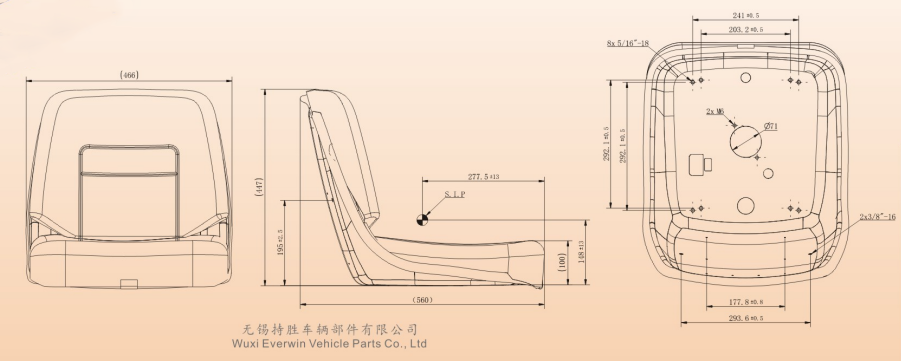
The mounting matrix of any industrial vehicle involves a precise mechanical interaction between the seat pan, the slide rails, and the forklift engine cover or battery box deck. When you evaluate a forklift seat bolt pattern, you are looking at the specific geometric arrangement of threaded holes or welded studs that secure the operator's chair to the machine. This interface must withstand intense dynamic loads, continuous floor vibration, and the shifting weight of the operator during rapid directional changes or sudden braking.
Manufacturers utilize two primary configurations for this mounting interface: fixed-bolt configurations and adjustable track systems. Fixed-bolt designs feature static holes drilled directly into the seat base, requiring an exact dimensional match to the forklift deck. Adjustable track systems utilize slotted slide rails that allow the mounting bolts to shift laterally or longitudinally before final tightening, offering a degree of flexibility during installation.
Industry standards have coalesced around several common pre-drilled dimensions to streamline manufacturing and replacement. You will frequently encounter imperial measurements such as 11" x 11", 8" x 11", or 11.25" x 11" on North American equipment like Hyster or Crown. Global and metric-based manufacturers, such as Toyota or Komatsu, often utilize configurations like 230mm x 280mm (approximately 9.06" x 11"). Understanding these baseline dimensions helps maintenance personnel quickly identify whether a standard replacement will align with the existing deck holes or if specialized adaptation is necessary.
The type of forklift also dictates the mounting mechanics. Internal Combustion (IC) forklifts typically mount the seat directly to a hinged engine hood supported by gas struts. If you replace a basic pan seat with a heavy suspension model, the existing gas struts may fail to hold the hood open during engine maintenance. Electric forklifts usually mount the seat over the battery compartment, requiring clearance for battery extraction. You must account for these structural differences when evaluating the mounting matrix.
Selecting the correct replacement involves navigating the fundamental differences between Original Equipment Manufacturer (OEM) components and aftermarket alternatives. OEM seats offer direct-fit guarantees. Because they are manufactured to the exact specifications of the forklift's serial number, they align perfectly with the factory mounting holes, electrical harnesses, and spatial constraints of the cabin. However, this precision often comes with longer lead times and limited availability for older or obsolete machinery.
Conversely, a universal forklift seat provides a highly versatile and readily available alternative. These designs incorporate slotted rails and multiple pre-drilled hole patterns to accommodate a wide variety of machine decks. While they offer exceptional procurement speed and flexibility, they require strict validation. Maintenance technicians must verify that the slotted rail adjustability actually aligns with the existing deck holes and that the overall footprint does not interfere with the steering column or hydraulic controls.
Balancing procurement speed against potential installation complexity requires a thorough trade-off analysis. OEM parts eliminate installation friction but may stall operations if parts are backordered. Universal options keep fleets moving but demand a higher level of technical competency during installation to ensure structural integrity and safety compliance are maintained.
Feature | OEM Seats | Universal Seats |
|---|---|---|
Fitment Guarantee | Exact match to factory specifications based on serial number. | Requires measurement and validation of adjustable slotted rails. |
Installation Complexity | Minimal. Direct plug-and-play installation. | Moderate. May require track adjustment or adapter plates. |
Availability | Subject to manufacturer stock and lead times. | High availability across various suppliers and distributors. |
Safety Switch Integration | Pre-wired with the exact factory connector. | May require splicing or swapping the existing OPS switch. |
Hardware Included | Usually utilizes existing factory hardware. | Often requires sourcing specific Grade 8 mounting bolts. |
Before touching a wrench, the installation process begins with accurate data collection. Locate the forklift's data plate, typically riveted to the dashboard, engine cowl, or overhead guard mast. This plate contains the exact make, model, year of manufacture, and serial number of the machine. This information is the baseline for all maintenance activities and component replacements.
Cross-reference these details with the manufacturer's service manual or technical databases. Many suppliers maintain comprehensive cross-reference guides that map specific forklift models to known replacement profiles. Establishing this theoretical compatibility before taking physical measurements narrows down the options and highlights any known anomalies, such as mid-year manufacturing changes that altered the deck layout.
Accurate measurement requires the right environment and the right tools. Gather a high-quality set of digital calipers or a rigid steel tape measure. Flexible measuring tapes can introduce unacceptable margins of error. You will also need adequate industrial lighting and basic hand tools, including a 1/2-inch drive socket set and combination wrenches, to remove the existing seat and expose the mounting deck.
Strict adherence to safety protocols is mandatory. Follow this sequence to prepare the machine for measurement:
Park the forklift on a level concrete surface and lower the forks completely to the floor to remove hydraulic pressure.
Engage the parking brake and execute standard Lockout/Tagout (LOTO) procedures, removing the ignition key.
Disconnect the battery terminal if you are working near the OPS wiring harness to prevent accidental shorts.
Remove the existing seat using your socket set, taking care not to snap rusted or seized bolts in the chassis.
Clean the mounting deck thoroughly with a wire brush and industrial degreaser to expose the true center of the mounting holes.
The most critical phase of validating replacement seat compatibility is executing a precise center-to-center measurement of the existing deck holes. Measuring from the edge of a hole introduces errors based on the hole's diameter. Always measure directly from the dead center of one hole to the dead center of the corresponding hole.
Begin with the side-to-side width. Measure the exact lateral distance from the center of the left front bolt hole to the center of the right front bolt hole on the machine deck. Repeat this process for the rear holes to confirm the pattern is perfectly square or rectangular, rather than trapezoidal. Next, measure the front-to-back depth. Record the distance from the center of the front left mounting hole to the center of the rear left mounting hole, and verify this against the right side.
Document these measurements meticulously in both standard inches and metric millimeters. Because the industrial equipment market is highly globalized, you will frequently need to cross-reference imperial measurements with metric spec sheets provided by international suppliers. A measurement of 11 inches translates to 279.4 millimeters, and rounding errors can mean the difference between a smooth installation and a frustrating mismatch.
If you are evaluating a replacement that features slotted mounting tracks, you must measure the maximum and minimum width adjustments. Slide rails are designed to move laterally to accommodate different deck layouts. Measure the distance between the rails when they are pushed completely inward, and again when they are pulled completely outward to their maximum extension.
Compare this adjustable range to your recorded deck measurements. The deck holes must fall comfortably within this range. Furthermore, verify that the slide rail travel distance—the forward and backward movement—does not cause the seat to interfere with steering columns, hydraulic levers, or rear bulkheads. The operator must be able to adjust the seat for legroom without the mechanism binding against the forklift chassis.
When the physical measurements of the machine deck do not align with the new seat, universal adapter plates serve as the definitive engineering solution. Also known as bottom plates, these heavy-duty steel brackets bridge the dimensional gap. The adapter plate bolts directly into the forklift's existing deck holes using flush or countersunk hardware. The plate itself features a secondary set of pre-drilled holes or threaded studs that perfectly match the new seat's bolt pattern.
Evaluating the structural integrity of the adapter plate is critical. The plate must possess sufficient thickness—typically 3/16-inch or 1/4-inch steel—to withstand the full weight of the operator combined with the dynamic shock loads generated during operation. Flimsy plates will flex under vibration, leading to metal fatigue, loose hardware, and potential catastrophic failure of the mounting interface.
You must also calculate the impact on seat height. Adapter plates add vertical dimension to the installation stack. While this is usually only a fraction of an inch, it can affect operator headroom in low-clearance cabins or alter the ergonomic reach to the foot pedals. Ensure the added height does not push the operator outside the safe ergonomic operating zone defined by the equipment manufacturer.
Many aftermarket options utilize slotted mounting tracks to provide lateral flexibility. Adjusting these tracks requires precision to ensure the sliding mechanism functions smoothly after installation. Begin by slightly loosening the bolts that secure the slide rails to the bottom of the seat pan. Do not remove them entirely; loosen them just enough to allow the rails to slide laterally with firm pressure.
Expand or contract the mounting width to match your recorded deck measurements. The most critical aspect of this process is ensuring parallel alignment. If the left and right rails are not perfectly parallel, the sliding mechanism will bind when the operator attempts to move the seat forward or backward. Use a rigid tape measure to confirm the distance between the rails is identical at both the front and the rear before tightening the rail bolts to the required torque specification.
Faced with mismatched forklift seat mounting holes, some technicians may be tempted to simply drill new holes directly into the forklift hood or chassis. This practice is heavily discouraged by equipment manufacturers and strictly violates OSHA guidelines and industry safety standards.
Drilling into the chassis compromises the structural integrity of the engine cover, which is often engineered to serve as a load-bearing component or a protective shield in the event of a rollover. Furthermore, the space immediately beneath the mounting deck frequently houses critical infrastructure, including high-pressure hydraulic lines, electrical wiring harnesses, and fuel tanks. A single errant drill bit can cause catastrophic damage, create severe fire hazards, and instantly void the equipment warranty. Adapter plates are the only acceptable method for bridging mismatched patterns.
Physical fitment is only half the equation; electrical compatibility is equally vital. Modern industrial vehicles are equipped with an Operator Presence Switch (OPS) integrated into the seat cushion. This safety interlock detects the weight of the operator and instantly disables the transmission and hydraulic functions if the operator leaves the chair. When replacing the seat, you must verify that the new unit accommodates the existing safety switch wiring harness.
Determine whether your forklift utilizes a normally open or normally closed electrical circuit. You can test this using a standard digital multimeter on the old switch. Installing a seat with the incorrect switch type will immobilize the machine or cause the safety interlock to fail in a dangerous state. Never bypass the OPS due to incompatible seat designs. Bypassing safety switches is a severe OSHA violation that exposes operators to extreme risk and creates massive liability for the organization.
Upgrading to a mechanical or air suspension system significantly reduces operator fatigue by absorbing floor vibrations and shock impacts. However, suspension mechanisms require a larger physical footprint beneath the seat pan. You must ensure that the suspension housing fits within the spatial constraints of the forklift's cabin, particularly checking for clearance against the engine hood and side panels during full suspension compression.
Additionally, match the seat's weight rating to the operational environment and the demographics of your workforce. Suspension systems rely on specific weight ranges to function correctly, typically adjustable between 110 lbs and 285 lbs. If an operator exceeds the maximum weight capacity, the suspension will bottom out, transferring severe shock loads directly to the operator's spine. Conversely, if the operator is too light for a heavy-duty suspension, the mechanism will remain rigid, offering no ergonomic benefit.
A complete Forklift Seat replacement must elevate, or at least maintain, the ergonomic and safety standards of the vehicle. Evaluate the inclusion of high-visibility orange seatbelts, which allow floor supervisors to easily verify compliance from a distance. Check for integrated hip restraints, which prevent the operator from being thrown laterally during a tip-over event.
Assess the backrest angle and lumbar support features. Operators spend long shifts in these vehicles, and poor posture leads to chronic musculoskeletal injuries. Ensure the final installation maintains strict compliance with ANSI/ITSDF B56.1 safety standards for low and high-lift trucks. Every component, from the mounting bolts to the seatbelt retractor, must meet these rigorous industrial requirements.
Once you have validated the measurements, adjusted the rails, or installed an adapter plate, you can proceed with the physical installation. Position the new seat correctly on the forklift base. Carefully lower it onto the deck, ensuring the slide rails or the bottom plate perfectly align with the existing threaded holes or mounting studs.
Adopt the best practice of threading all mounting bolts by hand initially. Industrial chassis threads are often exposed to dirt, grease, and corrosion, making them highly susceptible to cross-threading. By hand-threading the bolts for the first few turns, you ensure they are properly seated in the threads. Never use an impact gun to start a bolt, as this can permanently damage the chassis mounts and necessitate complex thread repair procedures like installing a Helicoil. Apply a medium-strength thread locker (such as blue Loctite) to the bolt threads to prevent them from backing out under heavy vibration.
With all bolts properly started, proceed to tighten the hardware using a calibrated torque wrench. Consult the manufacturer's documentation for the specific torque ratings required for the mounting bolts, which typically range between 18 and 25 ft-lbs depending on the bolt grade. Tighten the bolts in a cross-pattern to ensure even clamping force across the mounting deck. Under-tightened bolts will vibrate loose over time, while over-tightened bolts can stretch the threads or crush the slide rails, impeding the seat's forward and backward movement.
After securing the mechanical interface, reconnect the seat switch wiring harness. Ensure the electrical connector clicks firmly into place and route the wire so it will not be pinched or stretched when the seat moves along its tracks. Use zip ties to secure any loose wiring away from moving parts. Before returning the forklift to active service, conduct a comprehensive functional test. Verify the slide rail mobility, test the seatbelt retractor, and confirm the OPS successfully disables the hydraulics when weight is removed from the cushion.
Successfully matching a forklift seat requires treating the mounting holes as a strict technical specification rather than a flexible guideline. Precision measurement, combined with rigorous make and model verification, dictates the correct procurement path and ensures a safe, compliant installation. Ignoring these dimensional realities leads to compromised structural integrity and severe operational delays.
Prioritize exact-match OEM seats for specialized equipment where cabin space is highly restricted. Utilize universal options with slotted rails for standard fleets to optimize procurement speed. Rely on heavy-duty adapter plates when mounting patterns inevitably clash. Above all, maintain the structural integrity of the machine by never drilling into the chassis.
To execute a flawless replacement, follow these immediate next steps:
Identify your forklift's exact make, model, and serial number from the data plate.
Remove the current seat and thoroughly clean the mounting deck to expose the existing holes.
Record the precise center-to-center width and depth of the bolt pattern using digital calipers or a rigid tape measure.
Verify the electrical circuit type of your Operator Presence Switch (OPS) using a multimeter.
Cross-reference all collected data points with the supplier’s technical schematics before initiating a purchase order.
A: Measure the distance from the center of one mounting hole to the center of the opposite hole, recording both the side-to-side (width) and front-to-back (depth) dimensions. Always use a rigid measuring tool and measure from dead center to dead center for total accuracy.
A: While knowing your make and model is an excellent starting point to consult supplier databases, you should always physically measure the existing mounting holes to account for any aftermarket modifications or mid-year manufacturing changes.
A: No. While universal seats feature adjustable slotted rails to accommodate multiple bolt patterns, they still have maximum and minimum width limits that must match your forklift's deck. You must validate these dimensions before installation.
A: Drilling new holes into the forklift chassis or engine cover is highly discouraged as it can compromise structural integrity, damage internal components like hydraulic lines, and violate OSHA safety compliance standards.
A: An adapter plate (or bottom plate) is a heavy-duty steel bracket that bolts into the forklift's existing deck holes and provides a new set of pre-drilled holes that match the replacement seat's bolt pattern, eliminating the need to drill the chassis.
A: Modern forklifts require an Operator Presence Switch (OPS) to function. The replacement seat must have a compatible switch (or a cavity to install the old one) to ensure the machine's safety interlocks operate correctly and disable hydraulics when the operator stands.